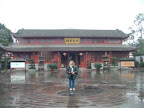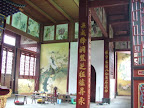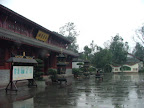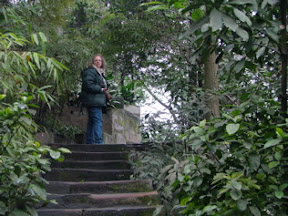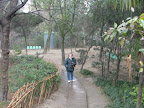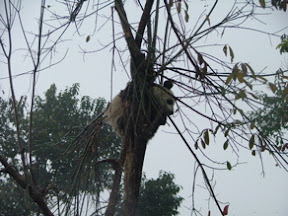
The next morning we were awaken by my alarm clock and quickly prepared for a visit to the Giant Panda Breeding Research Center. This project is not only a point of pride for the city of Chengdu; but, for the entire nation of China.

On the way we met several other westerners. They were all engaged in short tours of China, ranging from a week to three weeks. One of them, Helen, tuned out to be a resident in our Hostel. In route we talked about various points of interest in P.R. China and places that we, as a group of travelers, had either visited or intended to visit.
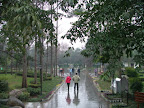
I hate to sound negative about the Giant Panda Breeding Research Center; however, I think that the trip that I went on with Michelle was the best of the trips made by Michelle and Myself, Debra, or Zeneta and I. I think that a large part of the trouble was the rain, it rained nearly the entire time we were in Chengdu, the other part of the time it snowed.
The trouble was that many of the Pandas were not out. While they do not hibernate, they were hiding from the weather. Zaneta's other observation was that they were not what she had expected; of course, this is part of the reason that we travel, and do other things to gain authentic experience, to separate truth from prejudice (being used in its proper form, to pre-judge, not as a pejorative). Her observation was that for a species called the GIANT Panda, they were not all that big.
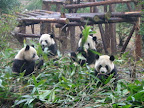

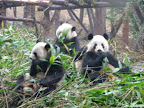
The rain also kept a lot of the smaller, yearling, pandas inside. The worst of it, though, was that there was no opportunity to hold the Red pandas, which is something that Zeneta had really looked forward to. I do feel bad abut her missing this. Hearing me tell her how fun it was served as a poor substitute for authentic experience. All I can imagine is that some people had complained about being handed a lap full of wet panda resulting in that part of the tour being closed in wet weather. That was the biggest disappointment of the entire trip.




From there we returned to our Hostel and had lunch with Helen. After lunch we met with Tray Lee and traveled, with a French couple, to the Sichuan Opera.
The building itself was located in an older section of town and had a slightly rundown feel to it. This look and feel is common throughout China due to a common disdain for maintenance and cleaning (however, the toilet was surprisingly clean, and the floor was dry).
Before the Sichuan Opera began, Tray Lee arranged for, and encouraged us to go backstage and watch the application of the makeup, by the actors and actresses. Gender of the actor did not determine the gender role in the performance and women frequently played in male roles.
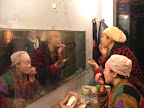
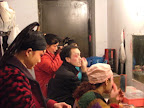
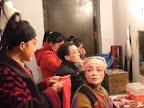
At this time he discussed the history, and the present, of the Sichuan Opera. As a public art, it receives no funding from the government and is financed, in large part, by private and corporate contributions. A critical amount of the funding now comes from a single woman, who has an interest in preserving this unique theater art.
He described it as a dieing art. It was easy to see what he meant, there were very few young actors. Even more noticeable, there were no young people in the audience. While the theater was near full, the entire audience, the four tourists excepted, was an older crowd.
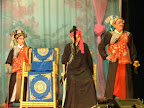
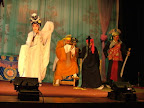
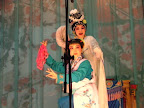
The Opera was divided into four parts. Each was a separate scene from classic, full length, Chinese Operas and were not related to each other. So, effectively, it was four separate plays told in a short story format.
While he did not provide full translation, Lee sat behind us and told us the important points of the scenes. The result was that it was quite easy to understand. Injustice, corruption, and bureaucracy seemed to be a recurring theme.
In the first play, which takes place in a court room, a man is wrongly accused of murder. In order to be cleared of his crime the court needs a head. So, his nephew killed himself and left a note that his head be taken and presented to the judge.
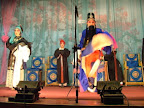
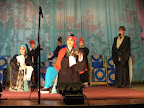
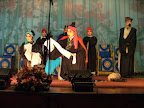
The judge quickly determined that the head was not the head that was needed to clear the uncle of the crime. However, in reexamining the case it became clear that the man being held was probably the wrong man. As a result, he, the judge, promised to examine the case and ordered that the man being held was to be treated well, in prison, while the case was investigated further.
In the second act, a dutiful wife is preparing for her mother-in-laws birthday party while her husband, a general, is away. She also presents, what appears to be a part of a continuing series of requests that her mother-in-law consider changing allegiances. However, her mother-in -law refuses to consider doing this because she would risk loosing her status.
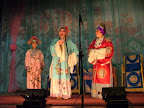
At this point, the General arrives home which comes much to everyones surprise. He is at a loss for how, but finally informs his mother that he has lost an important battle. His mother then enters into a long speech where she tells him that he should regain his losses, die trying, or kill himself, a Chinese form of, "return with your shield or on it."
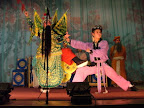
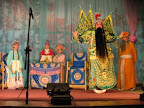
The third act was, nearly, a solo performance telling the story of an agent of the emperor who was investigating a corrupt official and was thrown into the officials illegal prison. In this prison he finds the body of the last agent sent to investigate this official, along with the proof that he needs, on the body of the other agent. Toward the end of the scene he is aided in his escape by a servant woman who he promises to marry.
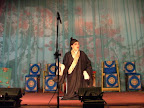
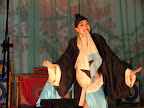
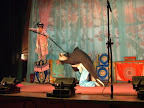
The final act featured the story of a young man that had been condemned to death because the father of the girl he wanted to marry objected to the marriage and, being wealthy and well connected, arranged to have him arrested and sentenced. This scene use all of the actors, bar one, and ended with the the young man imploring his intended bride to go on with her life without feelings of guilt; to go and find a suitable husband and live a happy live.
From there, we had Tray's driver drop us off at the Woodfish, the restaurant that we had tried to find previously. A quick review of the Woodfish; I didn't really like it. It was expensive and the servings were not large. It was certainly more of a restaurant than a cafe and featured western place settings.
We then walked back to our hostel. I spent some time in the recreation room while Zeneta prepared to nod off. One complaint I have to state about The Loft Hostel, which is similar to the other hostel that I stayed at, in Chengdu, last year, is the lack of heat. Chengdu, being south in China, is not considered a cold city. The result is that the heat does not work particularly well.
Keep in mind that it was snowing. With this picture of the weather, understand that the recreation room had no heating whatsoever; further, the room we were in had a radiator the never, truly, got hot. In general, the Chinese treat heating as an unnecessary luxury.